Double Crested Cormorant, Phalacrocorax auritus
Facts and Information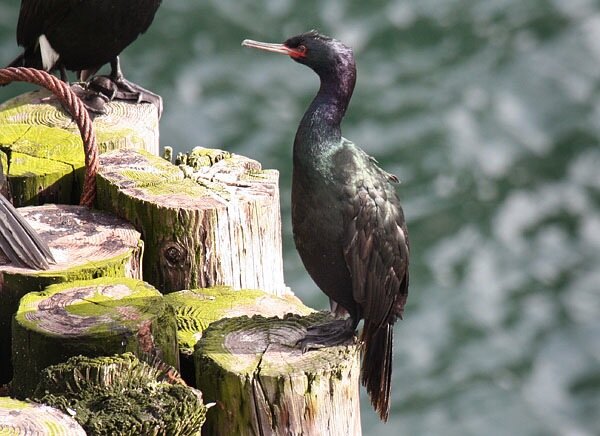 The Double Crested Cormorant is a completely black waterbird, with white plumes on the head during breeding season. It is just over 2 feet long, with a wingspan of nearly 4 feet. Double Crested cormorants live on the outer coast but can also move inland to brackish waters, and fresh-water lakes. The Double Crested Cormorant is a completely black waterbird, with white plumes on the head during breeding season. It is just over 2 feet long, with a wingspan of nearly 4 feet. Double Crested cormorants live on the outer coast but can also move inland to brackish waters, and fresh-water lakes.The Pelagic Cormorant (Phalacrocorax pelagicus) is a small seabird that lives along the northern Pacific coast, and all around San Juan Island and surrounding areas. They grow to about 29" with a wingspan of just over 3 feet. They are typically all black with a beautiful, distinctive iridescence, and white thighs during breeding season. They have a long thin bill and the large, webbed feet. These iridescent feathers became cemented in my imagination after reading, "The Island of the Blue Dolphins," by Scott O'Dell, in which a young girl, Karana, is left alone on an island and has to find a way to survive. She makes clothing out of cormorant feathers, and the description was so vivid to me I never forgot the name of the birds! Nests are made from grasses or seaweed and built on islands and rocky shores. While they occasionally alternate between several nesting sites from year to year, it is more common that they remain faithful to a favorite nesting site for their entire lives, repairing and improving it if necessary. Older, rebuilt nests can grow to a size of 5 ft deep. Jump over to any of the other San Juan Island bird pages: American Bald Eagle, Belted Kingfisher, Common Raven, Coopers Hawk, Great Blue Heron, Pileated Woodpecker, Red-tailed Hawk, Red-winged Blackbird, Rufous Hummingbird, Sea Hawk, Yellow Rumped Warbler, Great Horned Owl, Wild Turkey, Trumpeter Swan. Return to American Goldfinch from Double Crested Cormorant, OR
|


